Factions, wars and diplomacy
Give two factions overlapping zones and different needs, and diplomacy does the rest: alliances form, trade follows, wars start when one side runs short. The Faction inspector shows currency and standing.
A peaceful world is usually not a peaceful design - it is an unfinished one. Factions do not fight because they dislike each other; they fight because two of them want the same thing and one of them can take it. If you want drama, you build the conditions and wait.
What factions actually do
| Behaviour | Trigger | What you see |
|---|---|---|
| Generate quests | Unmet needs | Quest entries on members and in the faction inspector |
| Craft | Enough currency | Food, items and equipment appear in faction storage |
| Equip | Crafted gear available | Heroes and soldiers carry better equipment |
| Trade | Complementary needs | Goods move between factions instead of being fought over |
| Ally | Shared threat or mutual benefit | Standing changes in the faction inspector |
| Declare war | Competition over a zone or resource | Zones flip when one side wins |
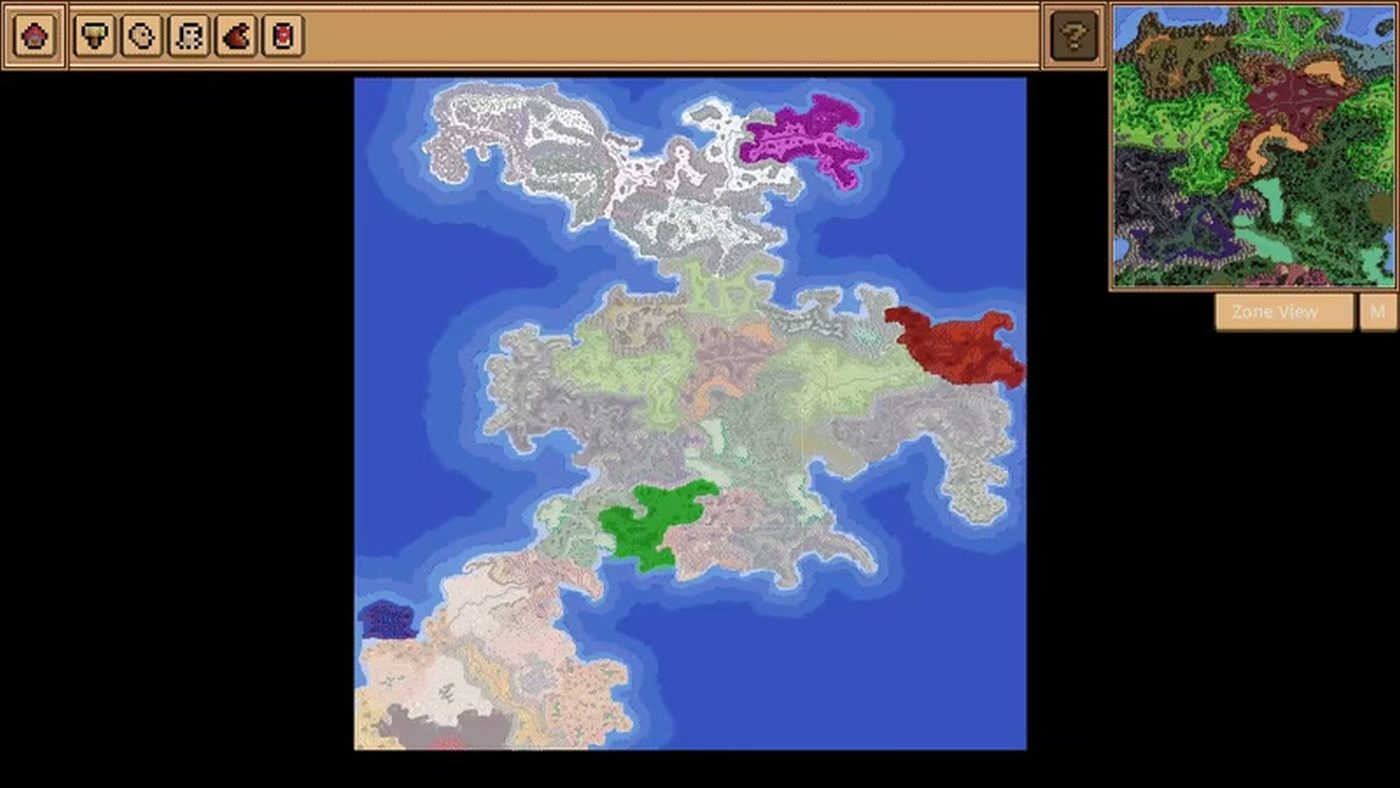
| Capture | Military advantage plus a conquerable zone | Ownership colour changes on the map |
Every row above is downstream of two things you control: what the factions need, and what the map lets them reach.
Seeding a rivalry in five steps
- Give each faction a resource the other lacks. One has ore, the other has farmland. Do not make them self-sufficient.
- Put a conquerable zone between them. A neutral zone with something worth having is the cleanest war starter.
- Keep both factions strong enough to try. A faction that is obviously doomed will not produce an interesting conflict, it will just lose.
- Add a shared threat on the far side. A monster zone raises threat level and pushes the two factions toward a temporary alliance before the real fight.
- Run at x2 or x3 and watch the faction inspector. At x5 the whole arc compresses into minutes and you will miss the decision point.
Step 4 is the one people skip, and it is the one that makes the politics legible: an alliance that forms because of a threat, then breaks when the threat is handled, tells a story you can actually follow.
Currency is the quiet system
Faction currency is tracked in the faction inspector, and it is the gate on everything a faction can do at scale: crafting food, crafting items, crafting equipment and distributing it.
That makes currency a balancing lever you can use without touching combat numbers. A faction with rich territory and no craftable goods will accumulate currency and do nothing with it; a faction with poor territory and cheap recipes will equip soldiers it cannot feed. Both are interesting, neither is stable, and stability is what wars are made of.
If a war never happens in your world, check currency before you check aggression. A faction that cannot afford equipment is not going to start a border dispute, no matter how much it dislikes its neighbour.
Alliances and trade
Alliances form and break, and trade moves goods between factions. Both are responses to need rather than switches you flip. In practice:
- Trade needs complementary production. If both factions make the same three things, there is nothing to trade.
- Alliances need a shared problem. A common monster zone or a third faction that threatens both is the reliable way to produce one.
- Both are reversible. A system that only escalates is boring; the point of diplomacy is that yesterday's ally is tomorrow's problem.
The zone editor is where you create the shared problem, because creature spawns and ownership live there. A zone nobody owns, sitting between two factions and spawning creatures, is a diplomacy machine.
Zones change hands - make that visible
Capture is represented by zone ownership. Two consequences follow.
First, the map is the scoreboard. Use zone colour and category colour so that ownership reads at a glance; a border you cannot see is a border you cannot debug.
Second, keep a couple of zones not conquerable so that a faction can lose a war without being deleted from the world. A faction with a permanent capital can rebuild, which produces a second war later instead of an empty map.
Reading the faction inspector
The faction inspector is the closest thing the launch build has to a history panel. It reports currency, standing, and the zones a faction holds. It does not tell you what happened three days ago, so the practical technique is to check it regularly rather than after the fact - a war you notice on day two is a system you can study, and a war you notice on day forty is just a changed map.
What is missing at launch
Quest and event authoring do not exist yet, so faction behaviour is generated from needs rather than scripted by you. The quest and event editors are scheduled for the first 2027 update, which is when hand-authored political storylines become possible. Until then, the design lever is scarcity: fewer resources, more neighbours, more contested ground.
The simulation guide covers the loop these behaviours sit inside, and the systems table lists every system with the panel that reports it.