How the simulation actually works
Factions generate needs-based quests, heroes pick them up, zones change hands when control slips, and the Region, Faction, Zone and Creature inspectors tell you which of those is happening. The player sets the stage; the simulation runs the play.
The simulation is the part of Fantasy World Manager that people either love or bounce off, and the difference is almost always whether they understand the loop. It is not automatic world generation in the Worldbox sense - the developer has been explicit that a fully automatic Box Mode is a 2027 feature. In the launch build the player builds the stage and the simulation runs the play on it.
Here is the loop, as the panels describe it.
The loop in seven steps
| Stage | What happens | Where you see it |
|---|---|---|
| Needs | Populations, heroes, soldiers, animals and monsters accumulate hunger and nutrition state | Creature and population panels |
| Goals | Factions turn their needs into quests | Faction inspector |
| Action | Heroes and soldiers pick up quests and travel | World view, quest state on the creature |
| Resources | Factions earn and spend currency, craft food, items and equipment | Faction inspector |
| Conflict | Threat level rises, zones get dangerous, diplomacy shifts toward war or trade | Zone and faction inspectors |
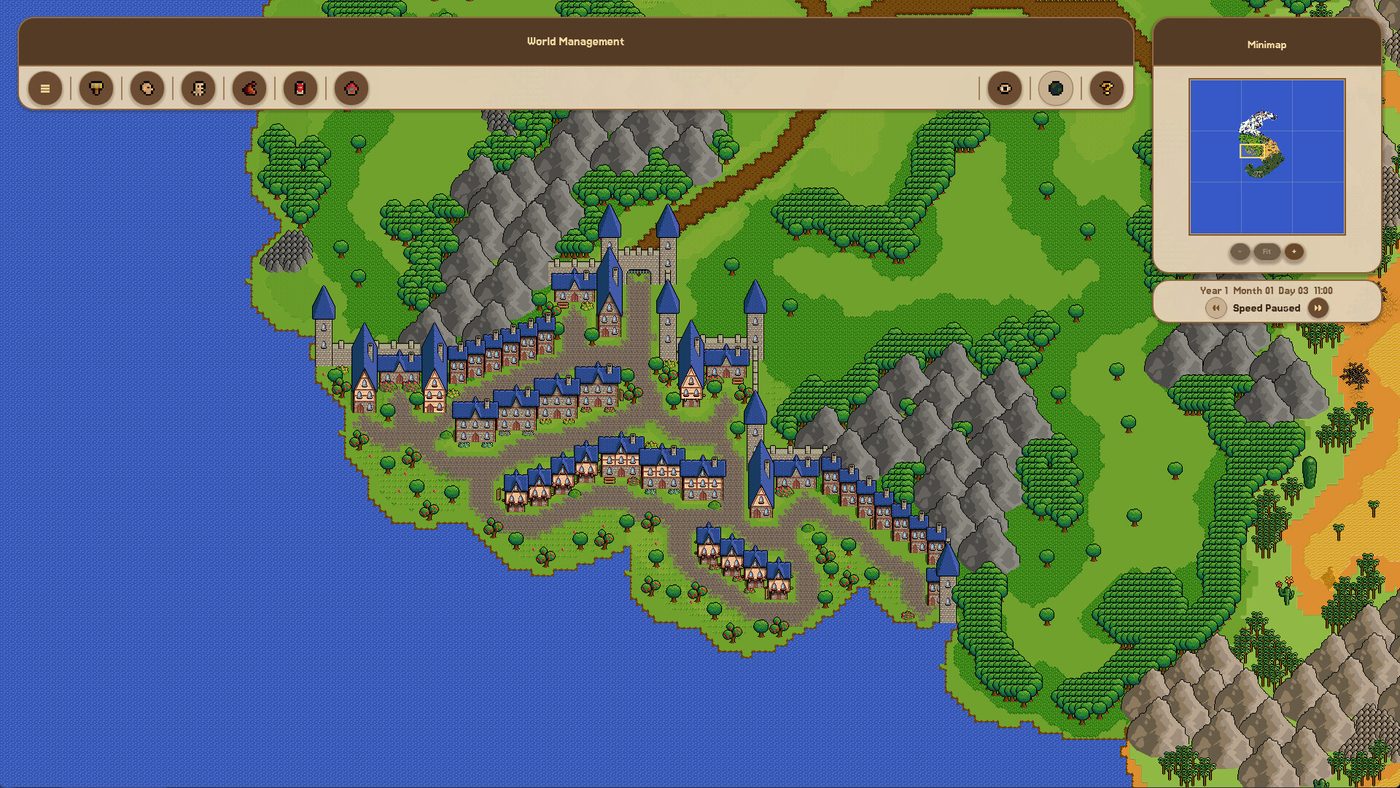
| Consequence | Zones are captured, borders move, populations change | Zone ownership colour on the map |
| Time | Characters age and eventually die, freeing roles for the next generation | Creature panels |
Nothing in that list requires you to intervene. All of it requires you to have built something with needs to satisfy and neighbours to compete with.
Needs and hunger
Hunger and nutrition apply to every population category: ordinary population, heroes, soldiers, animals and monsters. Individual characters can have a favourite food, which is a small detail with a large effect on trade - a faction whose people want something it does not produce has a reason to trade or to take it.
This is the system that makes an economy exist without you designing one. If your world has food variety and factions that do not all produce the same thing, trade emerges. If every faction is self-sufficient, diplomacy has nothing to negotiate.
Quests are generated, not authored
In the launch build, factions generate quests from their needs. There is no quest editor yet - it is scheduled for the first 2027 update, alongside the event editor. What that means practically:
- You cannot hand-write a quest chain. You shape the conditions and the faction writes the goal.
- Quest quality tracks the world's design. A faction with a single unmet need produces a single kind of quest.
- Multiple factions with overlapping needs produce competing quests, which is where the interesting behaviour lives.
If your world feels repetitive, the fix is more varied needs and more contested resources, not more factions.
Currency, crafting and equipment
Factions track their own currency, visible in the faction inspector. That currency pays for faction-level crafting: food, items and equipment. Crafted equipment can then be distributed to heroes and soldiers rather than sitting in a stockpile.
This is the chain that connects your item design to what you see on the map. If you build a strong weapon and no faction can afford to craft it, nothing changes. If you build it cheap and the faction equips soldiers with it, the next border dispute resolves differently. The item editor guide and the equipment guide cover the authoring side.
Threat level and danger
Threat level affects monster aggression and how dangerous a zone is. It gives a zone a direction: a quiet forest can become a problem area without you touching the spawn table again.
Two uses worth knowing. Put a high-threat zone on a border and the factions sharing it get a common enemy, which tends to produce alliances. Put it inside a single faction's territory and you create internal pressure - that faction spends resources on a problem instead of on its neighbour.
Diplomacy, war and capture
Factions form alliances, wage wars and trade. Zones change hands when control slips. The faction and zone inspectors are the only reliable way to see why: a war that looks unprovoked is usually a need that went unmet for a season, and a zone that flipped is usually one whose owner could not hold it.
The faction and diplomacy guide goes into how to seed a rivalry deliberately.
Ageing and lifespans
Characters age and die. This is easy to forget while watching a stable village, and then a generation turns over and the settlement looks different. Lifespans are also the reason long simulations drift: the heroes you equipped at year one are gone by year ten, and their replacements inherit the world you built, not the one you remember.
Why nothing happens: a diagnosis order
When a world runs and nothing occurs, check in this order.
- Are there zones with owners? No ownership means no politics.
- Are the zones adjacent and conquerable? Isolated or unconquerable zones cannot change hands.
- Do factions have unmet needs? Self-sufficient factions have no reason to act.
- Do creatures spawn anywhere? No threat means no pressure.
- Is anything actually moving? If entities are static, pathing is the problem, not the simulation.
That order is deliberately cheap to check. Each step takes a minute in the inspectors, and most "the AI is dead" reports resolve at step one or two.
What the simulation does not do yet
It does not run a fully automatic world - that is Box Mode, scheduled for the first 2027 update. It does not let you script quests or events: those editors arrive in the same update. And it does not persist narrative memory in a way you can read; the inspectors show current state, not history.
The simulation systems table lists each system with what it touches, and the roadmap page shows when the missing pieces are due.